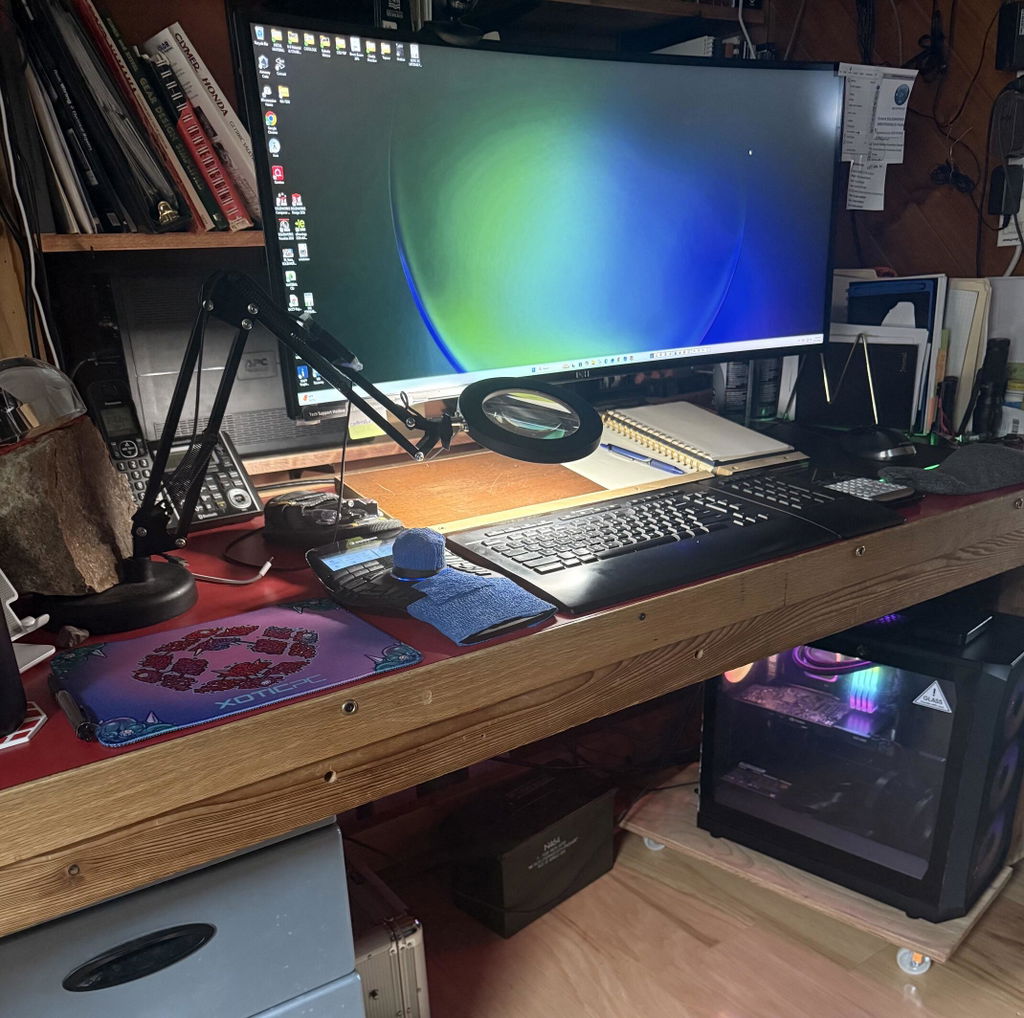


How to Choose a Gaming PC and Monitor Bundle in 2026
Last updated: May 5, 2026
A gaming PC and monitor bundle is a matched pair of a custom desktop computer and a display selected together so the GPU's resolution output, refresh rate, and frame rate align precisely with the monitor's capabilities — maximizing every frame the hardware produces without bottlenecking either component.
At XOTIC PC, every desktop is hand-assembled in Lincoln, Nebraska, torture-tested with OCCT before it ships, and backed by a Lifetime Parts & Labor Warranty — the only custom builder in the industry offering this standard on every desktop. Our bundle recommendations are built on 4K benchmark-verified data from real machines, not marketing claims.
For a broader look at selecting a complete gaming setup, see our guide: Best Custom Gaming PCs in 2026 — Complete Buyer's Guide.
2026 Gaming PC + Monitor Bundle Quick-Reference Table
Budget Tier |
Recommended PC |
Target Resolution |
Recommended Refresh Rate |
Recommended Monitor Spend |
GPU Tier |
|---|---|---|---|---|---|
~$1,100 |
1080p |
165–180Hz |
$149–$200 |
RTX 5060 |
|
~$1,650 |
1440p |
165Hz |
$239–$350 |
RTX 5070 |
|
~$1,800 |
1440p |
240Hz |
$300–$400 |
RTX 5070 Ti |
|
~$2,000 |
1440p / 4K |
144–165Hz |
$400–$600 |
RTX 5080 |
|
~$3,500+ |
G3 Pano or higher |
4K |
144Hz+ |
$600–$900 |
RTX 5090 |
What You'll Need Before You Start
A clear combined budget for both PC and monitor
Your primary game genres and target frame rates
Your target resolution: 1080p, 1440p, or 4K
Desk dimensions — ultrawide and 27"+ panels require more horizontal and depth clearance
A list of any existing peripherals sharing display outputs (capture cards, KVM switches)
Step 1: Set Your Combined Budget and Allocate It Correctly
Decide your total spend for PC and monitor together before touching a single spec sheet. The proven allocation rule in 2026 is 80–85% on the PC, 15–20% on the monitor. The GPU does the heavy lifting — the monitor amplifies what it produces.
Budget Tier Examples
$1,000–$1,200 total: ~$920–$950 PC / $149–$200 monitor — ideal for 1080p 165–180Hz competitive gaming
$1,600–$2,000 total: ~$1,400–$1,600 PC / $239–$400 monitor — ideal for 1440p 165Hz all-around gaming
$3,000–$4,000 total: ~$2,500–$3,200 PC / $600–$900 monitor — ideal for 4K 144Hz enthusiast builds
Pro Tip: Never buy a $700+ monitor for a $700 PC. The display will be bottlenecked by the GPU, and you will not perceive the benefit. Invest in the machine first, then scale the monitor to match it.
Step 2: Choose Your Target Resolution — Everything Else Flows From Here
Resolution is the anchor decision. It determines which GPU tier you need, which monitor tier to buy, and what frame rates are realistic at your budget. Make this call before evaluating any specific product.
Resolution Options in 2026
1080p (1920×1080): Maximum competitive frame rates (240Hz+), lowest GPU demand. Ideal for esports titles like Valorant, CS2, and Apex Legends.
1440p (2560×1440): The performance sweet spot in 2026. Balanced visual quality and high refresh rate. Works for both competitive and AAA single-player titles.
4K (3840×2160): Maximum visual fidelity. Requires an RTX 5080 or RTX 5090-class GPU for stable 60fps+ in demanding titles. Best for single-player, cinematic, and simulation games.
[STAT] Based on 3DMark Time Spy testing in 2026, the NVIDIA GeForce RTX 5080 (10,752 CUDA cores, 16GB GDDR7) delivers approximately 28,400 benchmark points — sufficient to sustain 4K 60fps+ in demanding AAA titles. The RTX 5070 available in builds like the G6 HYTE Y40 Gaming Desktop excels at 1440p high-refresh-rate gaming. [Source: 3DMark public benchmark database, 2026]
Pro Tip: If torn between 1440p and 4K, choose 1440p with a high-refresh panel. A 1440p 165Hz experience is more satisfying for most gaming sessions than 4K at 60fps — motion clarity matters as much as pixel density.
Step 3: Match Your GPU Tier to Your Resolution and Refresh Rate Target
Every monitor has two core specs your GPU must feed: resolution and refresh rate. If your GPU pushes 80fps at 1440p, a 165Hz monitor will sit at 80Hz most of the time. Match these intentionally — don't let either component wait on the other.
2026 GPU-to-Monitor Matching Guide
RTX 5060 / RTX 5070: 1080p 240Hz or 1440p 165Hz
RTX 5070 Ti / RTX 5080: 1440p 240Hz or 4K 120Hz
RTX 5090: 4K 144Hz+ or dual-monitor 4K setups
Recommended Catalog Bundles
1080p Competitive Bundle: G5 Pop 2 Vision Gaming Desktop + MSI MAG 244C 24" FHD 180Hz Gaming Monitor ($149). Total: ~$1,068. An RTX 5060-class machine driving a 180Hz 1080p panel is purpose-built for competitive esports in 2026.
1440p All-Rounder Bundle: GX13 HYTE Custom Built Gaming Desktop PC + ASUS TUF Gaming VG27VH1B 27" 165Hz Curved Monitor ($239). Total: ~$1,628. The GX13's RTX 5070-tier GPU sustains high frame rates at 1440p across both competitive and AAA titles.
4K Enthusiast Bundle: Focus Ghost Ready to Ship Gaming PC + a 4K 144Hz IPS monitor in the $600–$800 range. The Focus Ghost's RTX 5080 provides the sustained throughput needed for 4K without compromise. [Source: DisplayNinja 2026 Monitor Buying Guide]
Browse the full selection of hand-assembled desktops on our Gaming Desktops collection page to find the right GPU tier for your target resolution.
Step 4: Evaluate Panel Type for Your Primary Game Genre
At identical resolution and refresh rate, panel technology changes how motion renders and how colors look. This is the step most buyers skip — don't.
Panel Types Explained
IPS (In-Plane Switching): Best color accuracy, wide viewing angles, 1–4ms response. Best for: RPGs, open-world, content creation alongside gaming.
TN (Twisted Nematic): Fastest response times (0.5–1ms), budget pricing, mediocre colors. Best for: hardcore competitive esports where every millisecond is critical.
VA (Vertical Alignment): Highest contrast ratios (3,000:1+), deep blacks, some motion ghosting. Best for: strategy games, horror, and single-player cinematic titles.
OLED / QD-OLED: Perfect blacks, instantaneous pixel response, premium pricing. Best for: 4K single-player and simulation gaming. Note the burn-in risk with static HUD elements during extended sessions.
[STAT] According to DisplayNinja's 2026 panel comparison data, modern Fast IPS panels achieve average gray-to-gray response times of 1.2ms — versus 0.5ms for TN and 2–4ms for standard VA. At 165Hz, the perceptible difference between 0.5ms and 1.2ms response is negligible for the vast majority of players. [Source: DisplayNinja 2026 Panel Technology Report]
Pro Tip: In 2026, IPS panels have largely closed the response time gap with TN. For most gamers, a 1ms Fast IPS monitor delivers both competitive speed and accurate color — the best of both worlds without the washed-out visuals of TN.
Step 5: Confirm Adaptive Sync Compatibility Between GPU and Monitor
Adaptive sync eliminates screen tearing and micro-stutter by synchronizing the monitor's refresh rate to the GPU's output in real time. In 2026, this is non-negotiable for a smooth, tear-free experience. Verify your PC and monitor share a compatible sync standard before purchasing.
Sync Standards in 2026
NVIDIA G-Sync / G-Sync Compatible: Works with all NVIDIA RTX 50-series GPUs. "G-Sync Compatible" monitors are VESA AdaptiveSync certified and work with G-Sync at a lower price point than full G-Sync hardware module monitors.
AMD FreeSync Premium / Premium Pro: Native to AMD Radeon RX 9000-series GPUs. Also supported by NVIDIA RTX 50-series GPUs in G-Sync Compatible mode — giving NVIDIA GPU owners access to a wider monitor market.
Bottom line: Every XOTIC PC desktop currently ships with Windows 11 Home or Pro and NVIDIA Control Panel ready at first boot. If your build carries an RTX 5060, 5070, 5080, or 5090, pair it with any G-Sync Compatible or FreeSync Premium monitor, enable G-Sync in NVIDIA Control Panel, and your adaptive sync is active immediately.
Step 6: Verify Physical Connectivity and Desk Space
A monitor that cannot connect cleanly to your PC — or doesn't fit your desk — breaks the bundle before a single frame is rendered. Confirm these physical factors before checkout.
Connectivity Checklist
DisplayPort 2.1: Required for 4K 144Hz+ without DSC compression in 2026. All RTX 5000-series cards include at least one DP 2.1 output. Confirm your target monitor has a DP 2.1 input.
HDMI 2.1: Supports 4K 120Hz. Widely available on RTX 50-series cards and mid-to-high-end monitors. Avoid HDMI 2.0 for 4K gaming — it caps at 60Hz.
USB-C / Thunderbolt: Useful for single-cable power and display delivery. Primarily relevant for premium IPS and OLED panels.
Physical Space Checklist
A 27" flat panel requires a minimum of 24" horizontal desk clearance.
An ultrawide 34" panel requires ~31" horizontal clearance and at least 20" of desk depth.
Verify GPU clearance inside your case if adding a capture card — the G3 Pano Gaming Desktop ($1,579) and GX11 H9 Flow ($1,549) both feature full-tower, airflow-optimized cases with ample internal expansion room for multi-GPU and capture card configurations.
For a complete overview of monitor options available to pair with your build, visit our Gaming Monitors accessories collection.
Step 7: Validate the Bundle with Benchmark Verification After Delivery
Every XOTIC PC desktop is 4K benchmark-verified before it ships — documented to hit the performance targets it's sold on. When your machine arrives, align those verified benchmark numbers against your monitor's rated resolution and refresh rate to confirm the bundle is performing as a unified system.
Run 3DMark Time Spy (free tier available at 3dmark.com) at your target resolution immediately after setup. If your score lands within 5% of the published benchmark for your GPU tier, your bundle is calibrated correctly. If scores fall significantly short, contact XOTIC PC support — every desktop carries a Lifetime Parts & Labor Warranty covering parts and labor for the life of the machine.
[STAT] XOTIC PC runs every desktop through OCCT stress testing — CPU, GPU, RAM, and PSU — before shipping. OCCT's GPU stress test runs at 100% load for a minimum of 30 minutes, catching thermal throttling, instability, and component failures that basic Windows boot tests miss entirely. [Source: OCCT official documentation, 2026]
Pro Tip: Screenshot your 3DMark results immediately after first boot. This creates a baseline you can compare against if performance changes over time — useful for warranty claims and future upgrade planning.
Troubleshooting & Common Mistakes
My monitor shows tearing even with G-Sync enabled. What's wrong?
Open NVIDIA Control Panel → "Set up G-Sync" and confirm "Enable settings for the selected display model" is checked. Also verify your monitor is connected via DisplayPort — G-Sync does not activate over HDMI on most monitors. Restart after making changes.
I bought a 4K monitor but games look blurry at 4K. What happened?
Your GPU may be rendering at 1080p or 1440p and upscaling to 4K. Check your in-game resolution settings and set them explicitly to 3840×2160. Also verify Windows display settings (Settings → System → Display) show 4K as the active resolution on your monitor.
Can I pair an RTX 5070 Ti with a 4K 60Hz monitor?
Yes, but it underutilizes the GPU. An RTX 5070 Ti can push well above 60fps at 4K in most AAA titles — you'd be capping performance unnecessarily. Pair it with a 4K 120Hz or 144Hz panel to use its full capability. Upgrade the monitor when budget allows; the GPU is already ahead of a 60Hz display.
Does the monitor affect input lag independently of the GPU?
Yes. Input lag is separate from pixel response time. Most 144Hz+ gaming monitors in 2026 measure 4–8ms input lag — imperceptible in casual play. Competitive esports players should target monitors with measured input lag below 5ms at their maximum refresh rate. [Source: RTINGS.com monitor testing methodology, 2026]
Should I wait for newer monitor technology before buying a bundle in 2026?
No. QD-OLED and Mini-LED panels currently available at 1440p and 4K already exceed what current-generation RTX 50-series GPUs can fully saturate. Future improvements will primarily address display brightness ceilings and OLED burn-in longevity — not frame rate performance. Buy the bundle that matches your GPU today and upgrade the display independently in 2–3 years as OLED pricing normalizes.
This applies to air-cooled builds. Does liquid cooling change the GPU pairing logic?
The GPU-to-monitor matching logic is identical regardless of cooling method. Liquid cooling affects thermal headroom and sustained clock speeds under extended load — which can raise average frame rates by 3–7% in thermally constrained scenarios — but it does not change which resolution tier or refresh rate a given GPU tier targets. Liquid-cooled builds like the GX11 H9 Flow ($1,549) maintain higher sustained clocks, making them better matches for high-refresh 1440p than equivalent air-cooled configurations at the same price.
Build the Bundle That Performs as One System
Knowing how to choose a gaming PC and monitor bundle in 2026 comes down to one discipline: matching every spec so nothing is wasted and nothing bottlenecks. Start with your resolution target, match your GPU tier to it, select a panel type that fits your game genres, confirm sync compatibility, verify connectivity, and validate the bundle with benchmarks after delivery.
Whether you're building around the G5 Pop 2 Vision at $919 for competitive 1080p play or going all-in with the Focus Ghost at $1,599 for 1440p immersive gaming, every XOTIC PC machine arrives OCCT-tested, 4K benchmark-verified, and covered by a Lifetime Parts & Labor Warranty. The monitor completes the picture — literally. Choose it with the same intentionality you put into every other component in your build.
Ready to configure your system? Browse our full lineup of hand-assembled gaming desktops and pair your build with a monitor from our accessories catalog at XoticPC.com.
```
Part of our series on
📝 View this article as Markdown — a clean text version for AI assistants, citation tools, and easy copying.